
Proposal Videos: Real-Life Ideas and a Complete Filming Guide
This guide delivers a curated set of emotional, real-life marriage proposal videos plus the exact planning and filming steps you need to capture the moment beautifully on camera. Whether you are searching for a spark of inspiration or building a shot-by-shot plan, you will find both here.
What you will find on this page:
- Curated proposal video examples grouped by type: public surprise, private/intimate, destination, flashmob/creative, and funny/unexpected
- Short “why it works” notes for each clip so you can adapt the idea to your own story
- A practical filming and planning checklist, from scouting to the day-of reveal
- A DIY vs. professional videographer comparison with typical US price ranges
- Editing, sharing, and long-term preservation guidance
- Research-backed reasons why professional capture matters, and what to ask a vendor
If you are planning a proposal in Italy and want a full-service team to handle every detail, Proposalitaly’s destination planning is one option worth exploring near the end of this guide.
Table of Contents
- What makes a great proposal video?
- What makes a proposal video truly memorable?
- DIY or professional videographer — which is right for you?
- How to plan and film the surprise from start to finish
- When things go wrong — keeping the footage and the moment
- How to edit, share, and preserve the finished video
- Why professional proposal videos matter: research and filmmaker insight
- Key Takeaways
- The detail most people get wrong about proposal videos
- Planning a proposal in Italy? Proposalitaly handles everything
- Useful sources and further reading
What makes a great proposal video?
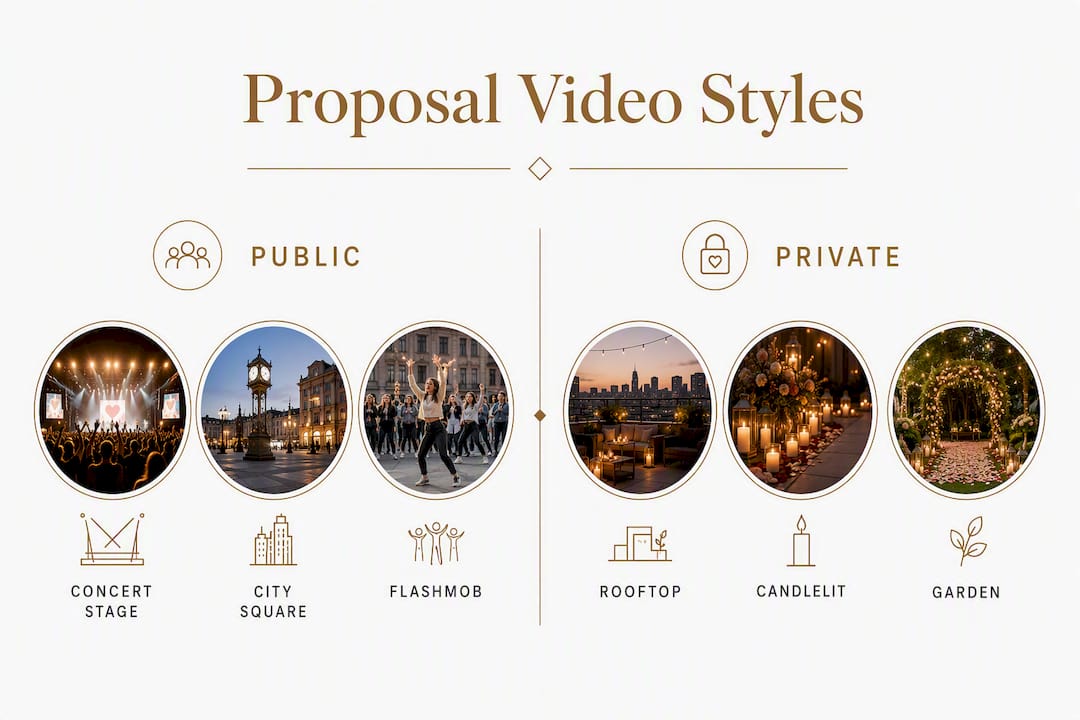
The best marriage proposal videos share one quality: they treat the day as a short narrative rather than a single frozen moment. Preparation, the journey to the location, the reveal, and the raw, unscripted reaction together form a story that people replay for decades. Below are five categories of proposal video, each with real-world examples and a note on what makes the footage work.
Public surprise proposals
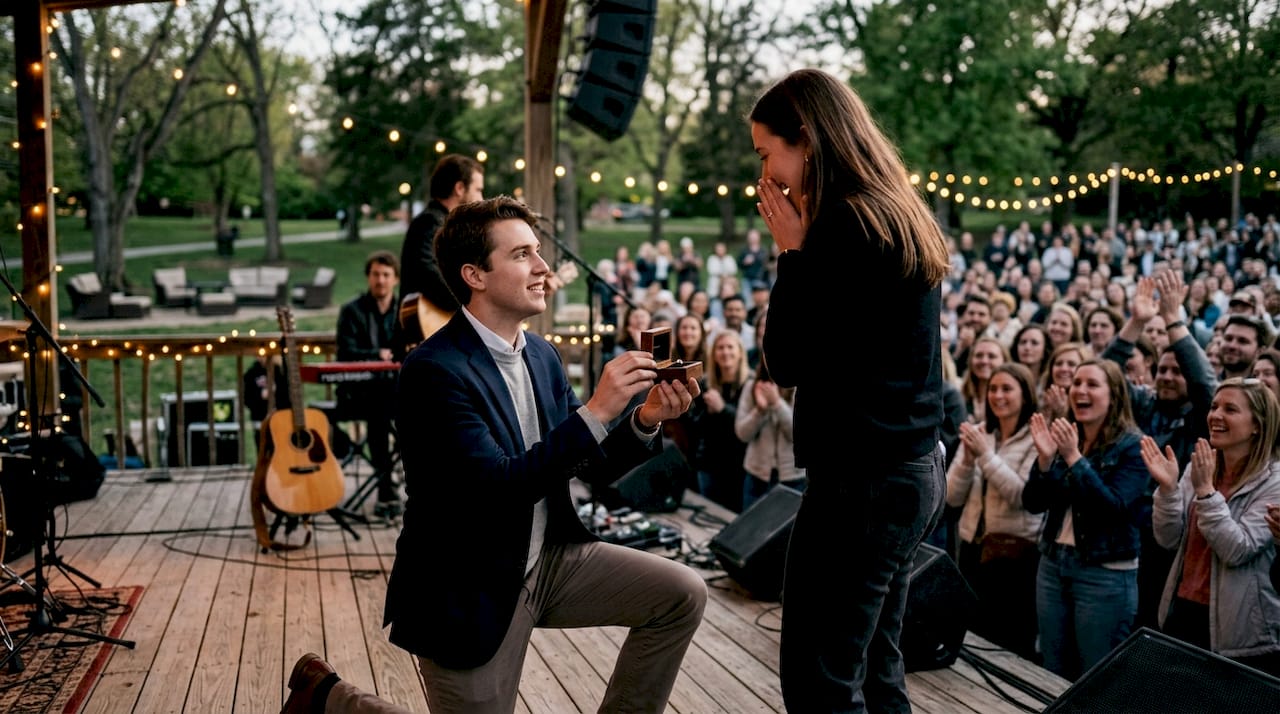
The concert-stage proposal. At a recent Nameless Festival in Lecco, a man named Nick proposed to his girlfriend Sharon in front of thousands of fans, with artist Conrad Taylor acting as the accomplice on stage. The crowd’s collective gasp and Sharon’s tearful reaction became the emotional peak of the clip. What makes it work: the wide crowd shot establishes scale, then the camera cuts tight to her face at the exact moment she realizes what is happening. The contrast between the enormous venue and the intimate human moment is what makes viewers feel something.
The city-square surprise. A classic format: one partner is led to a landmark plaza under a false pretense, while a friend films from a café table nearby. The handheld, slightly shaky footage actually adds authenticity. Logistics note: busy public squares in the US often require a filming permit for tripods or professional rigs; a handheld phone or small mirrorless camera usually avoids that threshold.
Private and intimate proposals
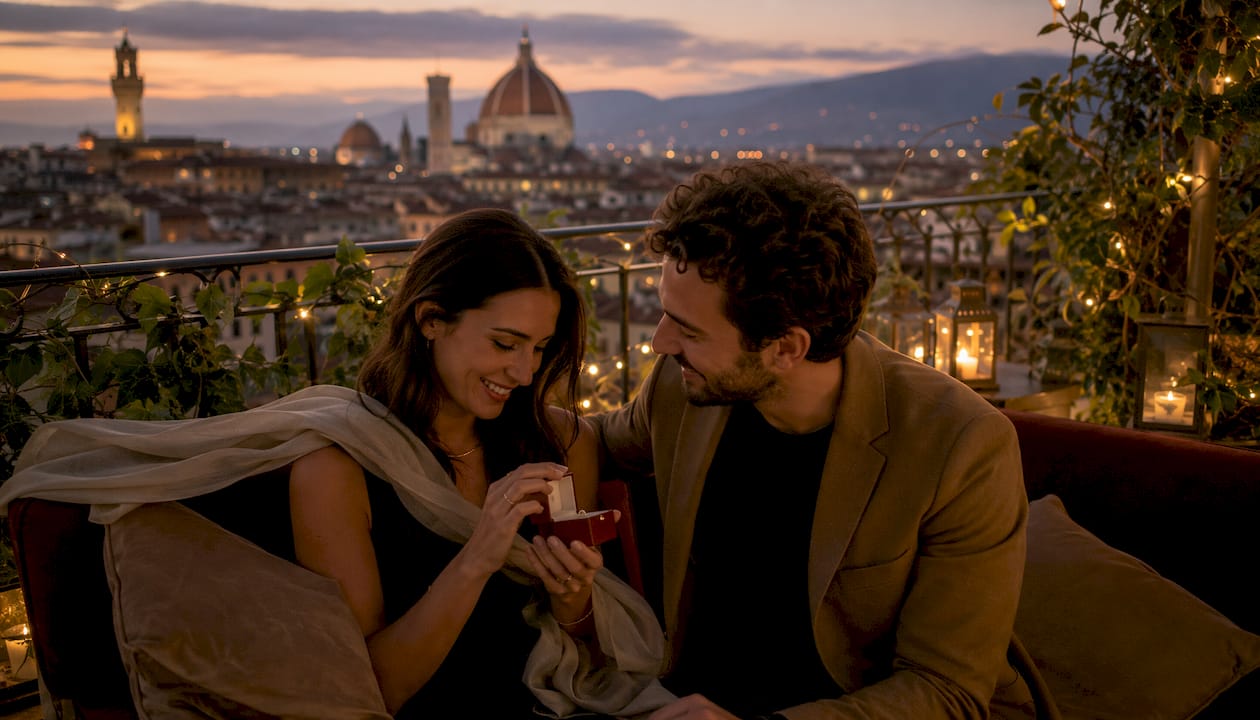
These videos trade spectacle for closeness. Think a candlelit apartment, a rooftop at dusk, or a quiet garden. The camera is usually positioned on a small tripod or bookshelf, framing the couple at mid-distance. What works here is sound: you can hear every word, every laugh, every quiet “yes.” Without a lapel mic or a close-placed recorder, this category falls apart entirely.
Destination proposals
A proposal at Lake Como, on the Amalfi Coast, or at a Tuscan vineyard carries built-in cinematic value. The landscape does half the storytelling. The most effective destination clips open with a wide establishing shot of the location, then cut to the couple walking toward the spot, then hold on the reaction. B-roll of the water, the light, the flowers adds context without slowing the emotional pace. Drone footage, when permitted, gives these videos a genuinely cinematic quality that no ground-level camera can replicate. See drone proposal ideas for permit guidance and shot concepts.
Flashmob and creative proposals
Flashmob videos succeed when the choreography is tight and the partner’s genuine confusion gives way to genuine joy. The key filming challenge is coverage: you need at least two cameras, one wide to show the full performance and one close on the partner’s face. A single-camera flashmob video almost always misses the reaction at the critical moment.
Funny and unexpected proposals
The ring drops. The partner walks away thinking it is a joke. A dog steals the bouquet. These moments, when captured, become the most-shared clips online precisely because they are unplanned. The lesson for anyone filming: keep the camera rolling no matter what. The mishap is often the memory.
What makes a proposal video truly memorable?
Great footage comes from decisions made long before the question is asked. Professional filmmakers emphasize that the most crucial work happens during hidden prep: selecting angles, testing lighting, and placing cameras so the videographer stays invisible.
Narrative elements
- Anticipation and setup: Footage of the proposer preparing, the journey to the location, and the partner arriving unaware. This is the opening act.
- The genuine reaction: The single most important moment. A close-up on the partner’s face, held for several seconds, is what people rewatch.
- The immediate aftermath: The hug, the tears, the laughter, the first phone call to a parent. This is where the emotional release lives.
- B-roll that shows context: The location, the ring box, the flowers, the surrounding light. These shots give the editor material to build a story around the reaction.
Technical elements
- Discreet camera placement (hidden behind foliage, on a ledge, or operated remotely)
- High-fidelity sound capture using a lapel mic on the proposer or a shotgun mic pointed at the couple
- Multiple angles so the editor has options at every emotional beat
- Stable framing (a small tripod, a gimbal, or a monopod) to avoid distracting shake
- Lighting awareness: golden hour light is forgiving; midday sun creates harsh shadows; indoor venues often need a small LED panel
Pro Tip: If you are using a professional videographer, ask them to place a lapel mic on the proposer before the moment. Mobile phones almost always fail to capture clear dialogue at distance, and losing the actual words “Will you marry me?” in the audio is one of the most common regrets couples describe.
The soundtrack matters more than most people expect. A well-chosen piece of music, placed under the reaction and aftermath, can double the emotional intensity of footage that is technically ordinary. The music should support the emotion already on screen, not substitute for it.
DIY or professional videographer — which is right for you?
The honest answer depends on three things: your budget, how much the finished video matters to you long-term, and how discreet the setup needs to be.
Comparing outcomes
| Factor | DIY | Professional |
|---|---|---|
| Image quality | Variable; phone cameras are capable but limited in low light | Consistent; cinema-grade sensors handle any lighting condition |
| Sound quality | Usually poor at distance; wind and crowd noise dominate | Clean dialogue via lapel or shotgun mic |
| Discretion | Hard to hide a friend with a phone; partner may notice | Two-person teams and remote rigs stay invisible |
| Storytelling in edit | Depends on the editor’s skill and available footage | Structured narrative with B-roll, color grade, and music |
| Turnaround | Same day to a few days | Typically 4–8 weeks for a handcrafted cinematic edit; faster with AI-assisted workflows |
| Social cuts | You create them | Usually included or available as an add-on |
Typical US price ranges
US-based proposal videographers generally fall into three bands:
- Entry-level ($300–$800): One camera operator, basic edit, short highlight reel, delivered digitally. Good for intimate indoor proposals where sound and light are controlled.
- Mid-range ($800–$2,000): Two-camera coverage, lapel mic audio, color-graded highlight film (3–5 minutes), social cuts. The sweet spot for most couples.
- Premium ($2,000–$4,500+): Full cinematic production, drone footage, multiple operators, custom soundtrack licensing, full-length film plus highlight and social cuts. Appropriate for destination proposals or couples who want a film-quality keepsake.
For context, European mid-tier cinematic services are often priced in the few thousands of euros, with AI-assisted packages available at lower entry points.
Decision checklist
- How much does the finished video matter to you in 20 years? If the answer is “enormously,” lean professional.
- What is your realistic budget? Under $500 makes DIY the only practical option; over $1,000 opens the mid-range market.
- How public or complex is the venue? A flashmob or destination proposal almost always needs a professional for coverage and discretion.
- Do you need the footage to be completely hidden from your partner? A friend with a phone is rarely discreet; a pro with a remote rig is.
- What output do you actually want? A 30-second Instagram clip is achievable DIY; a 4-minute cinematic film with a custom score is not.
How to plan and film the surprise from start to finish
Step-by-step checklist
- Choose your location and scout it in person. Walk the exact spot at the same time of day you plan to propose. Note where the light falls, where crowds gather, and where a camera could be hidden.
- Identify your camera positions. You need at least one close angle on your partner’s face and one wider angle showing the full scene. Mark both spots.
- Assign an accomplice. This person handles the camera, gives you the signal when everything is ready, and stays out of your partner’s sightline. Brief them with a written cue list.
- Check permit requirements. Many US national parks, monuments, and popular public spaces require a filming permit for tripods or professional equipment. Check with the venue or park authority at least two weeks in advance.
- Rehearse the timing. Walk through the approach route with your accomplice. Agree on a signal (a text, a wave, a specific song) that tells you the camera is rolling and positioned.
- Test your audio setup the day before. Record a 60-second clip at the location and play it back. If you cannot hear clear speech, add a lapel mic or move the camera closer.
- Arrive early on the day. Set up cameras and audio at least 30 minutes before your partner arrives. Rushing the setup is the most common cause of missed moments.
- Keep the camera rolling after the “yes.” The first five minutes after the proposal often contain the most emotionally rich footage: the embrace, the ring, the first phone call.
Gear and packing list
- Mirrorless or DSLR camera with a fast lens (f/1.8 or wider for low-light situations)
- Lapel (lavalier) mic clipped to the proposer’s clothing, connected to a small recorder
- Shotgun mic on a second camera for ambient and dialogue capture
- Small travel tripod or flexible gorilla-style mount for hidden placement
- Compact gimbal for any moving shots
- Spare batteries (at least two sets per camera)
- Extra memory cards (minimum 64GB per camera)
- Small LED panel or reflector for indoor or shaded locations
- Neutral-density filter for bright outdoor midday light
Pro Tip: For backlit scenarios, such as a proposal facing a sunset or a bright window, expose for your partner’s face and let the background blow out slightly. A silhouette is beautiful in a photo; in a video, losing your partner’s expression to shadow is a loss you cannot fix in post.
When things go wrong — keeping the footage and the moment
Mishaps are more common than polished viral videos suggest. Real-world proposal clips show that small technical or logistical failures are almost universal. The couples who end up with the best videos are the ones who planned for imperfection.
Common scenarios and quick fixes
- The ring drops. Keep the camera rolling. A dropped ring followed by nervous laughter and a successful recovery is a better story than a flawless kneel. Your accomplice should have a clear sightline to retrieve it quickly if needed.
- An unexpected crowd interruption. Stay calm and hold your position. The camera should stay on your partner’s face, not the interruption. Most crowds disperse within seconds.
- Your partner suspects something. Do not rush. A slightly suspicious partner who then genuinely breaks down in tears is more emotionally compelling on camera than a perfectly surprised one.
- The camera stops recording. This is why you have two angles. Check memory card space and battery levels before the moment, not after.
- Audio fails. If the lapel mic drops out, the shotgun mic on the second camera is your backup. Always run two audio sources.
One firm rule: if at any point your partner expresses genuine discomfort or distress, pause the plan. No video is worth overriding someone’s comfort or consent. A proposal that is postponed and rescheduled can still be filmed beautifully.
How to edit, share, and preserve the finished video
Editing priorities
- Start with the reaction. Pull every clip of your partner’s face at the moment of the proposal and in the minutes immediately after. These are your anchor moments.
- Build a 2–5 minute highlight. Open with a brief scene-setting shot (the location, the approach), move to the proposal, hold on the reaction, and close with the aftermath. Resist the urge to include everything.
- Add B-roll for context. The ring, the flowers, the location at golden hour, a wide shot of the two of you together. These shots give the edit breathing room.
- Preserve authentic audio where possible. The actual words spoken during the proposal are irreplaceable. Lay music underneath, not over, the dialogue.
- Color grade gently. A warm, slightly lifted grade suits most proposal footage. Avoid heavy filters that date the video quickly.
Backup and preservation checklist
- Export a master file in ProRes or H.264 at the highest available resolution
- Store the master on at least two physical drives kept in different locations
- Upload to a cloud service (Google Drive, Dropbox, or iCloud) immediately after export
- Name files with a date and description:
2026-06-15_proposal_master.mp4 - Create a separate folder for social cuts (vertical 9:16 for Instagram Reels, horizontal 16:9 for YouTube)
- Revisit your storage every two years and migrate to current formats as needed
Sharing and privacy
Before posting publicly, confirm that both partners are comfortable with the footage being visible. This matters especially when the proposal was filmed in a public space where bystanders appear on camera. In the US, most public spaces are considered fair game for filming, but individuals who are clearly identifiable in a private moment may have grounds to object. When in doubt, blur faces of bystanders in the background.
For sharing with family before a public post, use a private link (Vimeo’s password-protected sharing or a Google Drive link set to “anyone with the link”) rather than a public upload. Watermark draft cuts to discourage unauthorized sharing before you are ready.
Recommended final deliverables to request from a professional:
- Full unedited footage (raw files) on a drive
- Cinematic highlight film (2–5 minutes)
- Short social cut (60–90 seconds, vertical and horizontal)
- Exported in H.264 or H.265 at 4K or 1080p
Why professional proposal videos matter: research and filmmaker insight
According to industry data, 79% of couples who do not commission a professional video for major emotional milestones report regretting that decision within one year. That figure is striking because the regret is not about the proposal itself. It is about the footage. A moment that felt vivid and permanent in memory turns out to be surprisingly hard to reconstruct from a shaky phone clip taken by a nervous friend.
Professional filmmakers describe their core value as something that happens well before the question is asked. Hidden prep and on-site coordination — selecting angles, testing lighting, and placing a discreet camera setup — are where the real work lives. By the time the proposal happens, a good videographer has already solved every technical problem.
What professionals do that DIY typically misses
Experienced proposal videographers commonly operate with a two-person coverage model plus a remote or hidden rig. One operator follows the partner; the other records the proposer; the remote rig captures wide context without being seen by anyone. This three-angle approach gives the editor enough material to build a genuine narrative. A single friend with a phone gives the editor one angle and no options.
Post-production for a handcrafted cinematic proposal film typically takes 4–8 weeks. That timeline covers rough assembly, music selection, color grading, fine audio mixing, and a client review round. AI-assisted editing workflows can shorten delivery and automatically generate social-optimized cuts, which is why some vendors now offer faster turnaround at lower entry prices.
What to ask before hiring a videographer
- What deliverables are included, and in what formats?
- How many cameras and operators will be on-site?
- How do you handle audio capture?
- What is your post-production timeline?
- Who owns the footage rights after delivery?
- Do you carry backup equipment?
- Can you share a full proposal film (not just a highlight reel) from a previous client?
Key Takeaways
A great proposal video is built on three things: discreet preparation, high-quality audio capture, and an editor who leads with the reaction rather than the setup.
| Point | Details |
|---|---|
| Reaction is everything | Lead your edit with your partner’s face at the moment of the proposal — that is the shot people rewatch. |
| Sound makes or breaks it | A lapel mic on the proposer captures the words that matter; phone audio at distance almost always fails. |
| 79% regret not hiring a pro | Industry data show that 79% of couples who do not commission a professional video for major emotional milestones regret that decision within one year. |
| Plan for mishaps | Assign an accomplice with a cue list, run two audio sources, and keep the camera rolling through any imperfection. |
| Proposalitaly adds video to the plan | For proposals in Italy, Proposalitaly’s packages include optional videography and drone add-ons alongside a hidden photographer and on-site coordinator. |
The detail most people get wrong about proposal videos
There is a version of this conversation that focuses entirely on gear: which camera body, which lens, which editing software. That conversation misses the point almost completely.
The proposals that produce genuinely moving footage share one quality that has nothing to do with equipment. They were planned with the partner’s experience at the center, not the camera’s. The best-shot proposal video I have ever seen was filmed on a camera that cost less than $1,000. The worst was filmed on a cinema rig that cost ten times that. The difference was not the sensor. It was that the first couple had an accomplice who knew exactly where to stand, had rehearsed the timing, and had placed a lapel mic on the proposer the night before. The second couple had a beautiful camera pointed at the wrong angle at the wrong moment, with no audio backup.
Sound deserves more attention than it gets. Losing the actual words of the proposal to wind noise or crowd audio is a loss that no amount of color grading can fix. A $30 lapel mic and a small recorder clipped inside a jacket pocket solves that problem entirely.
The ethics of filming proposals in public spaces are worth taking seriously. In the US, filming in public is generally legal, but using footage commercially or posting identifiable bystanders without consent can create complications. When you hire a professional, ask explicitly how they handle consent and what their policy is on bystander footage. A good videographer has already thought through these questions.
For couples planning a destination proposal in Italy, Proposalitaly coordinates every element of this, including hidden photography and optional videography, so the couple never has to manage the logistics themselves.
Planning a proposal in Italy? Proposalitaly handles everything
If the planning checklist above feels like a lot to manage on top of an international trip, that is exactly the gap Proposalitaly fills. Rather than sourcing a videographer, scouting a location, arranging flowers, and briefing an accomplice yourself, you get a single coordinated team that has done all of it before, across 17 Italian destinations.
Every Proposalitaly package includes a reserved romantic spot, a hidden professional photographer, flowers, champagne, and an on-site coordinator. Videography and drone footage are available as add-ons, giving you a cinematic record of the moment without the logistics of hiring and briefing a separate crew. Pricing starts from a moderate entry level up to full luxury productions, with all pricing published transparently so you know exactly what you are booking.
To see what is available for your destination and dates, browse proposal packages and prices or message the team on WhatsApp for a tailored plan and quote within 24 hours. This is a paid service, presented here as one practical option for couples who want a fully coordinated experience in Italy.
Useful sources and further reading
The sources below were used in building this guide. Each one is worth reading if you want to go deeper on a specific aspect of proposal videography.
- Proposalitaly — Proposal packages and prices: Transparent pricing and package details for full-service proposal planning across 17 Italian destinations, including optional videography and drone add-ons.
- Proposalitaly — Destination proposal planning: Logistics and planning guidance for couples proposing abroad, with notes on how videography fits into a coordinated destination experience.
A note on copyright: Before posting your proposal video publicly, confirm that any music used in the edit is either licensed (through a service such as Musicbed or Artlist) or royalty-free. Using a copyrighted song without a sync license can result in your video being muted or removed on platforms like YouTube and Instagram. Your videographer should handle this if you hire a professional; if you are editing yourself, budget for a music license as part of your post-production costs.
This article provides general information about proposal video planning and is not legal advice. For questions about filming permits, privacy rights, or copyright in your specific location, consult the relevant local authority or a qualified professional.
Recommended
- Marriage Proposal Ideas for 2026 – Proposal Italy
- Marriage Proposal in Italy | Plan the Perfect Proposal — Kiss Me Italy
- How to Propose: The Complete Guide (2026) – Proposal Italy
- The Best Way to Propose: Expert Tips – Proposal Italy
Frequently asked questions
What makes a proposal video worth watching?
One clear emotional beat, captured without interruption. The best proposal videos hold on the reaction rather than cutting away, keep the audio clean enough to hear what was actually said, and stay short. A single unbroken minute beats three minutes of edited coverage almost every time.
Should I hire a videographer or film it myself?
If the moment is the point, hire someone. A hidden videographer frames the reaction while you stay present, and works to a signal so your partner never spots them. Filming it yourself works only if a friend can stay genuinely invisible and you have rehearsed where they stand.
Where should the camera be during the proposal?
Slightly off to the side and behind your partner’s eyeline, far enough away that a long lens is doing the work. That angle catches the face at the moment of realisation, which is the shot that matters, without anyone noticing a camera pointed at them.
How long should a proposal video be?
Sixty to ninety seconds for the version you actually share. Keep the full take for yourselves, but the edit people watch should start close to the question and end on the reaction, with no build-up that asks strangers for patience.
What should I do about sound?
Assume ambient noise will ruin dialogue and plan for it. A small clip-on microphone on your jacket, hidden under a lapel, is the single biggest upgrade to a proposal video. Wind off water and crowd noise in public squares are the two usual culprits.
Can a proposal video be arranged as part of a package?
Yes. A videographer can be added to any all-inclusive proposal package from €600, alongside the hidden photographer that is already included, and drone footage can be added from €500 where local rules allow it.


